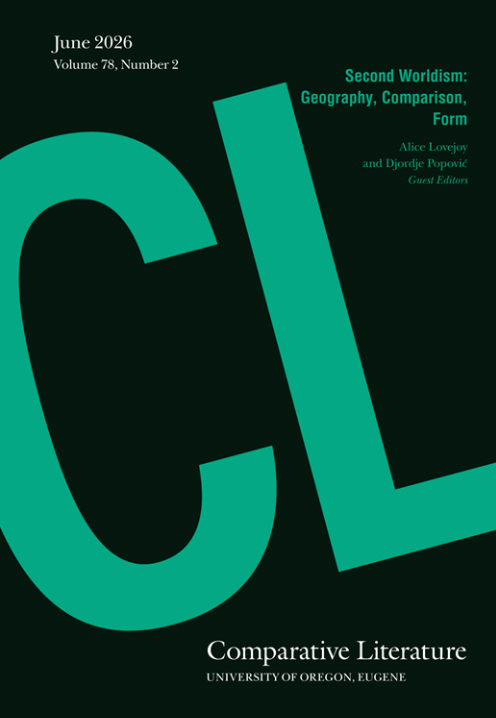
Congratulations to UConn German Studies faculty member Prof. Anna Horakova on her new publication in the special issue “Second Worldism: Geography, Comparison, Form” of the Comparative Literature Journal.
This thought-provoking issue, edited by Alice Lovejoy (U of Minnesota) and Djordje Popović (UC Berkeley), brings together scholars exploring the cultural and literary legacies of the “Second World” across geography, aesthetics, and comparative methodology. We’re delighted to see Prof. Horakova’s work featured alongside these outstanding contributions:
Memory in Motion: Revisiting the GDR in Jenny Erpenbeck’s Kairos
This article explores the aesthetics and politics of memory in Jenny Erpenbeck’s Kairos (2021), a novel that reimagines East Germany through a fragmented, collaged form that stages a fictionalized engagement with multiple archives. Framed as a “museum in the form of a book,” Kairos integrates an array of diverse sources, cultural artifacts, historical references, and personal documents to stage an encounter with the GDR’s complex legacy. Through the relationship between Katharina, a student of stage design, and Hans, a scriptwriter thirty-four years her senior, who is connected to both the socialist intelligentsia and the secret police (Stasi), the novel examines the collapse of a once-imagined socialist future. Drawing on the concept of “future archives,” the article argues that Kairos challenges dominant post-reunification narratives that reduce the East to repressive surveillance or commodified nostalgia. Instead, it pieces together a narrative of critical reflection that foregrounds lost socialist potentials while eschewing romanticization. The novel’s form—fragmented, intermedial, and resistant to closure—mirrors the labor of memory and the impossibility of definitively separating the wheat from the chaff in state socialism’s legacy. Kairos, the article argues, calls for a renewed engagement with this past—not to redeem it but to salvage critical traditions and alternative futures amid the ongoing consolidation of neoliberal consensus and the global rise of right-wing populism.
Congratulations!!!

